Own-API shop
For shops that already have an API key and run compute on their own endpoint.
- L1 Starter US$4.97/mo
- L2 Standard US$7.52/mo
- L3 Advanced US$12.62/mo
Export shop tool Languages Supply-chain AI shop
Easy stock and supply chain Switch shops AI stock assistant iStock▪X90 professional counter
With advanced technology and dedicated service,
Earn the trust.


Two modes. Choose according to whether your company already has its own API.
For shops that already have an API key and run compute on their own endpoint.
For shops that want platform compute and a monthly token quota, without connecting their own API.
Local model deployment is quoted separately.
IP and bandwidth are purchased separately and priced by the carrier.
Catalog, orders, supply chain, and a shop cluster, in one system.
Categories, brands, SKUs, and media are maintained in one back office.
Checkout, freight rules, and order status follow one flow.
Campaigns, coupons, and topic pages can be set per language.
Content pages, SEO keywords, Google optimization, and AI-engine optimization help the shop get found.
Several brands, domains, and sites. Data stays separate, in one system.
One account. Pick the shop before the back office, and switch without signing out.
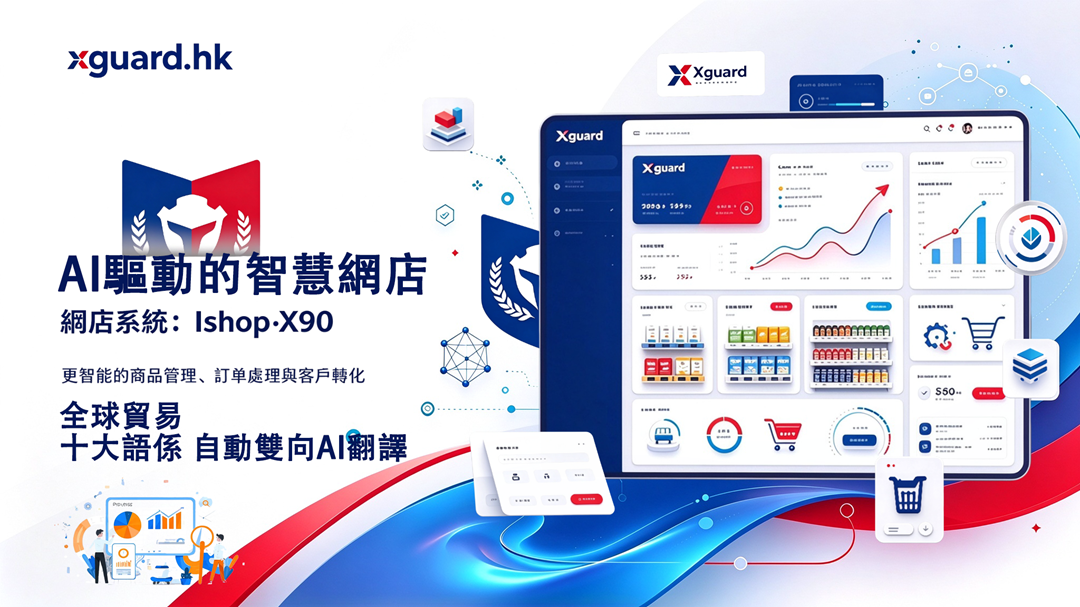
Ten-language storefronts and AI for global reach. The back office stays in Traditional Chinese, Simplified Chinese, and English, so staff can work in the language they use.
AI-driven, about ten times the output. The workload of ten people, handled by one.
GEO and SEO in one place, including accessibility.
A fully automated community that drives community marketing.
The supply chain stands apart from any one shop. A physical warehouse uses it to run goods. An online shop and its distributors use it to put stock, replenishment, and dispatch on one set of books. AI flags backlog and slow movers. A person confirms each suggestion.
The supply chain is its own system. It is not tied to one online shop. A physical warehouse uses it for locations, goods, and movement. Stores and the warehouse share one ledger.
The online shop and its distributors do not need a second stock system. Once they join the supply chain, orders deduct stock, shortages reorder, and goods go out to distributors from the same inventory.
An Android handheld scans SKUs on the floor. AI ranks count tasks from movement: heavy outbound, a sudden surge, or stock that has not moved. A person confirms before the books change.
Warehouse, on hand, reserved, and available sit on one ledger. Receipts, issues, and returns leave a trail, so you can see where the goods are and what is left.
The central warehouse and the branches share one supply chain. Shop sales, replenishment, and dispatch stay connected. Each store does not keep its own book.
Online orders draw the same stock. Checkout, stock-outs, and reorder points return to the supply chain. Goods leave the warehouse when they can be sold.
Outbound history suggests how much to buy and where to set the reorder point. The suggestion is shown first. Official figures change only after someone accepts it.
Goods arrive fast and sell slowly, so available stock piles up. The risk is marked, so cash and warehouse space are not tied up in SKUs that do not move.
Low outbound volume with stock still high raises an alert. It states how many left the warehouse, how many remain, and whether replenishment should stop.
An alert brings a reason and a next step. It takes effect when a person accepts it. AI does not place orders or change stock on its own.
Low outbound volume over a period, with available stock still high, is marked as slow-moving or backlog. The reason carries numbers: units out, available quantity, and the current reorder point.
The suggestion may be a clearance promotion, a transfer to a store that can sell it, or a stop on replenishment and a lower reorder point. When shipments are too few, it explains only and does not offer a quantity to adopt.
Accepting updates the reorder point or the quantity to purchase. Rejecting leaves the official figures as they are. AI does not change the stock balance and does not open a purchase order.
Some AI features are not fully disclosed. Please contact us.
Connect platform services, communities, APIs, and company platforms.
Connect existing platform services.
Connect communities.
Connect APIs.
Connect a company's own platforms.