散工管理系統與判頭管理系統的CIC登記與註冊整合
-
-
InfoDetail_Editor: Tony
-
80
- Wx Share
-
-
How to effectively manage casual laborers and foremen in the attendance and payroll system?
Time & Payroll Suite
Attendance, Payroll and Access Control Solution for Cost Reduction and Productivity Gains Details
All‑in‑one automated timekeeping and payroll system with robust, secure processes to guarantee payroll integrity. Includes leave management, shift rostering, multi‑site and chain support, multi‑ledger accounting, and comprehensive modules.
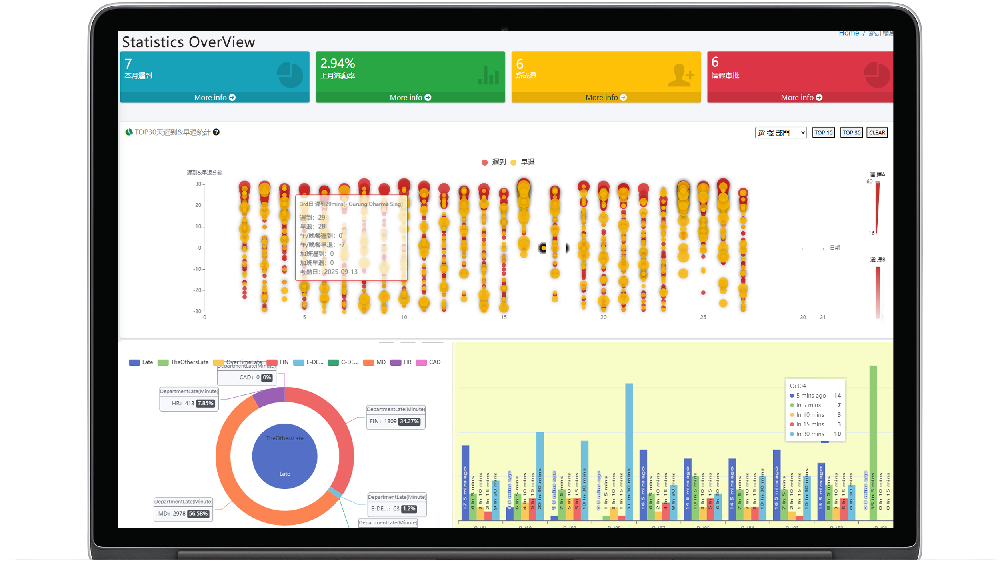
Hong Kong Construction Site Management: CIC Registration and Integration of Casual Worker Management and Subcontractor Management Systems
Casual workers on Hong Kong construction sites have irregular clock-in times, and subcontractors manually record attendance data, resulting in chaotic data. Now, a single system can accurately solve all these problems.
The attendance and payroll management challenges faced by the Hong Kong construction industry, particularly the non-periodic settlement of casual workers and the complexity of subcontractor management, have long been pain points. Based on the professional guidance in the DGX-HRMS system manual, we are able to build a comprehensive solution.
This system not only flexibly handles the irregular working hours of casual workers but also achieves efficient supervision and control through the subcontractor management system, while fully complying with the registration requirements of the Hong Kong Construction Industry Council (CIC).
01 System Infrastructure: DGX-HRMS's Multi-Modular Design
The DGX-HRMS system adopts a modular design, specifically optimized for the characteristics of the Hong Kong construction industry. The core modules include nine functional modules such as scheduling and attendance settings, attendance personnel management, leave and vacation management, and payroll and financial management.
The system features a dedicated "Hong Kong Construction Industry Module" specifically designed to address the high worker turnover and irregular working hours characteristic of the construction industry.
The system's role and permission system is clearly defined, with each role, from super administrator to ordinary employee, having specific operational permissions. According to the system manual, a "foreman" typically corresponds to a "department manager" role, possessing the authority to manage their team members; while casual workers fall under the "employee" role, only able to view their individual attendance and pay information.
This hierarchical permission design ensures data security and effective management.
Notably, the system supports data integration with regulatory platforms, providing the technical foundation for CIC registration and licensing. The system configuration file can store the login account and password for the construction industry CWR cloud platform, achieving seamless integration of attendance data with regulatory requirements.
02 Precise Management of Casual Worker Attendance: From Setup to Calculation
The core challenge of casual worker management lies in the irregular working hours and non-periodic pay settlement. The DGX-HRMS system effectively solves these problems through flexible scheduling settings and intelligent calculation rules.
For casual worker A in the user example (working hours 10:00-19:00, including a 1-hour lunch break), the system setup process is as follows:
First, create a flexible scheduling plan for casual worker A in the scheduling and attendance settings module. Set the start time to 10:00, allowing a 1-hour buffer before and after; set the end time to 19:00, also allowing a 1-hour buffer before and after; the lunch break can be set to a fixed 1 hour, allowing a 20-minute buffer before and after.
When casual worker A actually clocks in at 10:05, has lunch from 12:30-13:30, and finishes at 19:10, the system will automatically recognize that this is within the allowed buffer range and normally calculate the working hours as 8 hours and 5 minutes (minus the 1-hour lunch break).
The system's core calculation logic is based on standard labor working hours. If casual worker A works more than 8 hours on a certain day, the system will automatically recognize the overtime hours and calculate overtime pay according to preset rules. For situations where there are days with no work and days with work, the system will calculate pay based on the actual percentage of scheduled tasks completed.
If casual worker A is required to complete 5 working days in a week but only completes 3, the system will calculate the week's pay at a 3/5 ratio to ensure fairness and accuracy.
For missed clock-ins or invalid clock-in time spans, the system provides a manual adjustment function, but this requires administrator privileges. The system manual specifically states: "The purpose of the manual scheduling and attendance calculation function is to change the calculation status after missed or missed clock-ins, so as to recalculate the data." This function ensures the accuracy and completeness of the data.
03 Supervisor Management System: Supervision, Approval, and Report Analysis
The supervisor is given the "Department Manager" role in the DGX-HRMS system, possessing comprehensive functions for managing team members.
The supervisor's core management functions include supervising attendance and payroll, approving leave applications, and generating statistical reports.
Regarding attendance supervision, the supervisor can view the clock-in records, working hours, and anomalies of the casual workers under their management in real time. The system's attendance record list function allows supervisors to quickly identify employees who are late, leave early, or miss clocking in, and to follow up on these issues promptly.
Leave management is a crucial part of a supervisor's responsibilities. The system's leave and vacation modules support online leave application and approval processes. After casual workers submit leave applications through the system, supervisors receive a notification and can quickly approve or reject applications based on project progress and staffing arrangements.
All leave records are automatically categorized and archived by the system for easy later retrieval and statistical analysis.
The reporting function is a core tool for supervisor management. The DGX-HRMS system provides various report formats, including Microsoft Crystal Reports and Excel Template Reports. Supervisors can generate various statistical reports, such as:
Leave Statistics Reports (categorized by type and time period), Attendance Anomaly Reports (identifying employees who are frequently late or leave early), and Work Hours Analysis Reports (understanding the workload of casual workers).
These reports not only help supervisors better manage their teams but also provide data support for project management.
The system's dual authorization mechanism ensures management security. Certain critical operations, such as resetting passwords and setting up approval processes, require specific roles and permissions to execute. This design prevents abuse of permissions and ensures system and data security.
04 CIC Registration and Integration: Compliance and Data Interoperability
The Hong Kong Construction Industry Council (CIC) registration requirements set clear standards for site management. Many design features and functions of the DGX-HRMS system directly support the compliance requirements of CIC registration and integration.
The system's "Hong Kong Construction Industry Module" is specifically designed for the characteristics of the construction industry, handling industry features such as high worker turnover and irregular working hours, which aligns perfectly with CIC's requirements for site management systems.
The system supports data integration with regulatory platforms, a key requirement for CIC registration. The system manual explicitly states: "Batch data import from the company's specific regulatory platform into the attendance system"—this function allows attendance data to be seamlessly integrated into CIC's regulatory system.
The system's role system includes a dedicated "LRO (Regulatory Organization)" role, specifically designed for "government agencies, third parties, or government oversight departments." This means that regulatory agencies can access system data with specific permissions, achieving transparent regulation, fully complying with CIC's regulatory requirements.
The system's multilingual management function supports Traditional Chinese, Simplified Chinese, and English, and allows for the redefinition of industry-specific terminology by company. This is particularly important for the multilingual environment of the Hong Kong site and also meets CIC's requirements for system usability.
Data security and privacy protection are key focuses for CIC. The DGX-HRMS system ensures the security of worker information and attendance data through hierarchical access control, operation log recording, and encrypted data transmission, meeting CIC's data protection standards.
05 Practical Operation Guide: System Setup and Daily Management
To achieve efficient management of casual laborers and foremen, proper system setup and daily operation are crucial. The following is a practical operation guide based on the DGX-HRMS system:
System Initialization Setup: First, company registration and basic settings need to be completed by a system administrator or administrator role. The system manual specifically emphasizes: "Registering the system's head office requires an administrator role. The process involves first registering the system user and then assigning an administrator (Admin) role before registering the system's head office."
Importing Casual Worker Information: The system offers multiple methods for importing casual worker information, including batch import, manual entry, and import from the monitoring platform. When importing in batches, worker lists must be prepared according to the downloaded template format to ensure accuracy and completeness.
Setting Rules: Personalized scheduling rules can be set for different types of casual workers. For casual workers with irregular working hours, flexible scheduling with reasonable buffer times is recommended; for casual workers with fixed tasks, task-oriented scheduling schemes can be set.
Assigning Supervisor Permissions: Assign the "Department Manager" role to each supervisor and associate them with the casual worker teams they manage. Simultaneously, configure specific operational permissions for supervisors according to actual management needs to ensure effective team management.
Daily Attendance Supervision: Supervisors should regularly review the attendance anomaly reports generated by the system and promptly follow up on and handle cases of lateness, early departure, and missed clocking in. The system's manual adjustment function is used for handling special cases, but should be used with caution and operation records should be kept.
Payroll Calculation and Disbursement: The system automatically calculates casual worker wages based on attendance data, including regular working hours, overtime hours, and various subsidies. Accountants and cashiers can complete the final review and disbursement of wages through the payroll and finance module.
Report Generation and Analysis: The system regularly generates various statistical reports to analyze casual worker work patterns, contractor management effectiveness, and overall project progress. This data is not only used for daily management but also serves as a crucial basis for CIC registration and supervision.
In a large-scale site project in Kwai Chung, Hong Kong, after the contractor adopted the DGX-HRMS system, the casual worker attendance error rate dropped from 15% to below 2%, and wage disputes decreased by 70%. Contractors, through the system's reporting function, accurately grasped the work patterns of each casual worker, rationally allocated human resources, and improved project efficiency by 25%.
The system's automatically generated compliance reports further enabled the company to successfully pass the CIC's annual registration audit.
Software Service
Industry information

- Views 42
- Author :Tony Law

- Views 55
- Author :Tony Law

- Views 66
- Author :Bruce Lee

- Views 69
- Author :Tony
- Views 61
- Author :Ben Tsoi
- Views 87
- Author :Tony
- Views 488
- Author :Tony































Hardware & Software Support
We are deeply rooted in Hong Kong’s local services, specializing in hardware and software issues.
System Integration
Hardware and software system integration to enhance stability and reliability.
Technical Support
Professional technical team providing support.
Professional Technical Services
Focused on solving problems with cutting‑edge technologies.