How Can Scheduling Optimization Reduce Labor Costs? A Cost-Benefit Analysis of DGX-HRMS
Are scheduling errors driving up labor costs? DGX-HRMS helps businesses reduce errors and disputes and optimize their HR cost structure through scheduling and payroll automation. From a cost-benefit perspective, this article analyzes the importance of scheduling management to attendance and payroll systems, and shares practical steps for HR to optimize human resources.
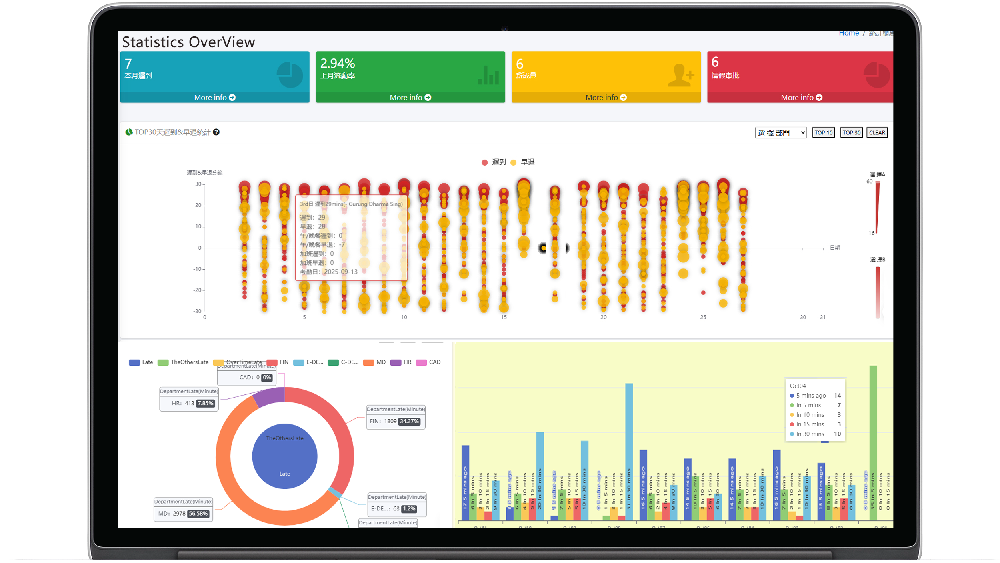
Time & Payroll Suite
Attendance, Payroll and Access Control Solution for Cost Reduction and Productivity Gains Details
All‑in‑one automated timekeeping and payroll system with robust, secure processes to guarantee payroll integrity. Includes leave management, shift rostering, multi‑site and chain support, multi‑ledger accounting, and comprehensive modules.
In today's highly competitive business environment, labor costs are often one of a company's largest expenses. However, many managers focus only on salary figures while overlooking the profound impact of scheduling management on overall labor costs. Scheduling errors not only lead to overtime pay overruns and payroll calculation mistakes, but may also trigger labor disputes that erode company profits. This article examines, from a cost-benefit perspective, the importance of scheduling to attendance and payroll systems, and explains how DGX-HRMS helps HR optimize human resources and achieve cost reduction and efficiency gains through automated scheduling and payroll calculation.
The Cost of Scheduling Errors
Scheduling management may seem routine, but once errors occur, their chain reactions often exceed expectations. Common scheduling problems include: staffing arrangements disconnected from actual demand, employee overtime not detected in time, and temporary shift changes causing chaotic attendance records. These problems directly or indirectly drive up labor costs.
Runaway Overtime Costs
When scheduling fails to accurately reflect business peaks and troughs, employees may be forced to work overtime, and if overtime pay is calculated manually, omissions or double-counting easily occur, causing companies to pay unnecessary overtime costs. Over time, this hidden cost can be considerable.
Payroll Calculation Errors and Disputes
When scheduling data is disconnected from attendance records, the basis for payroll calculation becomes inaccurate. For example, if part-time employees' working hours are not accurately recorded, payroll calculation may underpay or overpay, causing employee dissatisfaction or even labor disputes. Handling disputes not only consumes management time but may also affect team morale and company reputation.
Compliance Risks
Labor laws in various jurisdictions have clear provisions on working hours, rest days, overtime compensation, and more. Scheduling errors may cause companies to violate regulations and face fines or legal action. These risks are especially prominent in industries such as chain retail and food service. (Note: Specific regulatory requirements need to be manually verified.)
The Link Between Scheduling and Payroll: Why Is Scheduling So Important to Attendance and Payroll Systems?
Scheduling is the starting point for attendance and payroll calculation. An accurate scheduling plan provides a baseline for attendance, and attendance data in turn is the basis for payroll calculation. If scheduling, attendance, and payroll systems are independent of one another, data must be manually cross-checked and transferred repeatedly, which is not only inefficient but also error-prone. Therefore, integrating scheduling management with attendance and payroll systems is key to improving HR management efficiency.
As an integrated attendance and payroll management system, DGX-HRMS seamlessly connects scheduling, attendance, and payroll. Shift scheduling management (B3) supports multiple modes such as fixed shifts, rotating shifts, and flexible shifts. Managers can quickly create shift schedules based on business needs, and the system automatically syncs scheduling data to the attendance module. Employees record attendance via GPS, clock-in, or sign-in, and the data is instantly imported into the payroll calculation engine, enabling automated payroll calculation (B1). This linkage mechanism ensures data consistency and greatly reduces human error.
DGX-HRMS Cost Control Features
DGX-HRMS provides multiple features addressing the pain points of scheduling and payroll management to help companies control labor costs.
Shift Scheduling Management (B3)
The system provides an intuitive scheduling interface, supports multiple shift settings, and can perform smart scheduling based on factors such as employee skills, availability, and workload. Managers can quickly preview scheduling conflicts and avoid overtime arrangements. When schedules change, the system automatically notifies the relevant employees, reducing communication costs.
Automated Payroll Calculation (B1)
The payroll calculation engine supports multiple currencies, multiple accounts, and multiple settlement cycles, and can automatically calculate base salary, overtime pay, allowances, deductions, and more based on attendance data. The system has built-in formulas for various payroll items and can be flexibly configured to meet the needs of different industries. Automated payroll calculation not only saves HR time but also ensures calculation accuracy, avoiding disputes caused by errors.
Flexible Attendance Calculation (B2)
The system supports multiple attendance methods, including GPS location clock-in, mobile sign-in, and facial recognition, suitable for different scenarios such as offices, stores, and construction sites. Attendance data is uploaded in real time, and managers can check attendance status at any time to promptly identify anomalies.
Leave Application and Approval Workflow (B4)
Employees can submit leave applications through the system, supervisors approve them online, and leave records are automatically linked to scheduling and payroll calculation, avoiding manual omissions.
Data Security and Permission Management (B8)
The system uses asymmetric encryption technology to protect sensitive data and provides granular permission management to ensure payroll data is accessible only to authorized personnel.
Steps for HR to Optimize Human Resources
To effectively optimize human resources, companies can implement DGX-HRMS according to the following steps:
Step 1: Assess the Current Situation and Pain Points
Review existing scheduling, attendance, and payroll processes to identify efficiency bottlenecks and sources of errors. For example, does scheduling changes frequently cause attendance chaos? Does payroll calculation require extensive manual cross-checking?
Step 2: Set Optimization Goals
Clearly define the goals you hope to achieve, such as reducing overtime expenses, lowering payroll error rates, and shortening payroll cycles. Goals should be specific and measurable.
Step 3: Choose the Right System
Choose a system like DGX-HRMS that integrates scheduling, attendance, and payroll, and consider deployment mode (on-premises/cloud), industry characteristics (such as the CIC construction industry interface), and customization requirements.
Step 4: Data Migration and System Go-Live
DGX-HRMS supports smooth migration and can import data from Excel or legacy systems. Conduct testing before go-live to ensure scheduling rules and payroll formulas are correct.
Step 5: Training and Continuous Optimization
Train managers and employees to become familiar with system operations. After go-live, regularly review data and continuously optimize scheduling strategies and payroll rules to achieve ongoing improvement in the human resource cost structure.
Conclusion: Make Scheduling a Cost Advantage
Scheduling management is not simply about arranging staffing; it directly affects attendance accuracy and payroll calculation efficiency, and in turn influences a company's labor costs. Through DGX-HRMS's shift scheduling management and automated payroll calculation, companies can reduce human error, lower dispute risks, optimize human resource allocation, and transform scheduling from a cost burden into a competitive advantage.
Want to learn how DGX-HRMS can save costs for your company? Book a free demo and let our consultants analyze the most suitable solution for you.
(Note: The regulatory-related content described in this article needs to be manually verified; please consult professional advice for specific implementation.)
































Featured Reviews
No reviews yet. Be the first to leave one.
Write a review
Supports bold and lists; do not paste external scripts or images
0 / 2000
Visible after review