Supply Chain as an Independent Foundation: How iShop.X90 Solves Multi-Channel Inventory Challenges
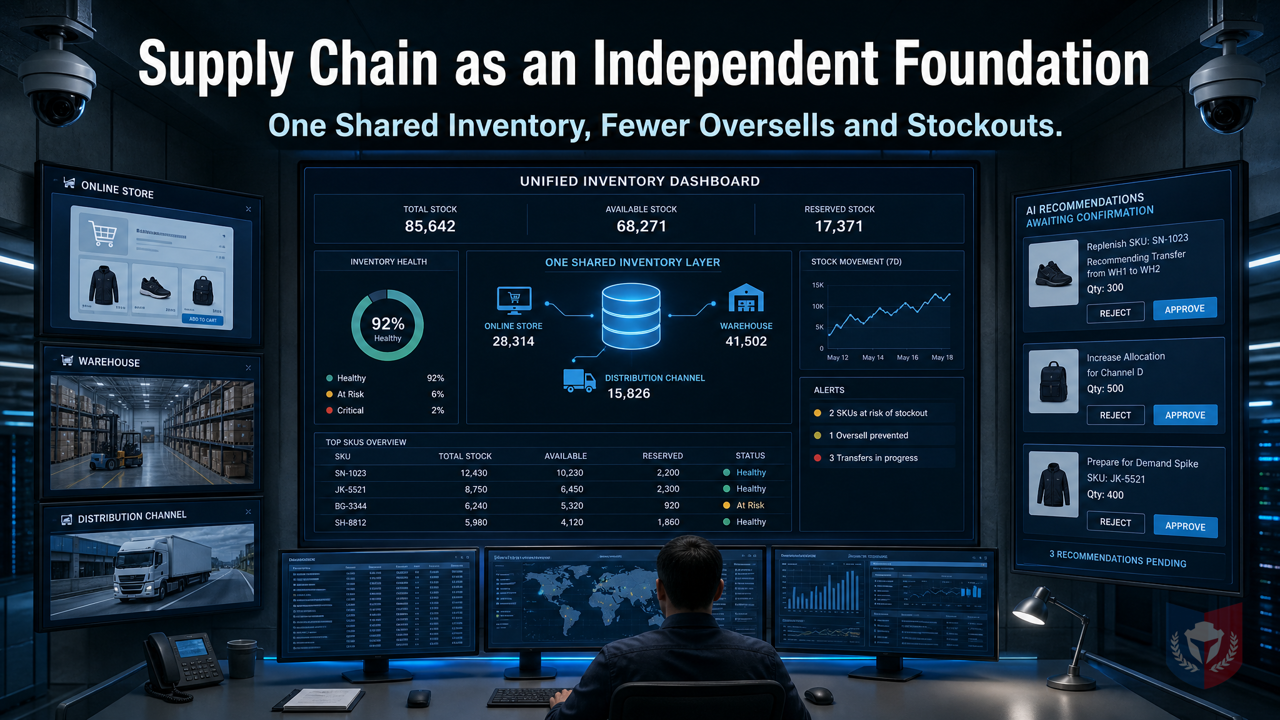
When online stores, physical warehouses, and distributors each manage their own stock, overselling, stockouts, and overstock become the norm. This article explores whether the supply chain should be attached to an online store or stand as an independent foundation, using iShop.X90 as an example to show that the supply chain is not a subordinate feature of any single online store but an independent foundation that lets stores, warehouses, online stores, and distributors share a single inventory ledger.
Online shop
An AI-driven online shop. Details
Raise output and day-to-day efficiency with AI.

In the retail and distribution industry, a common debate is whether the supply chain should be attached to a particular online store or stand alone as an underlying layer. Industry views differ, but in practice, when online stores, physical warehouses, and distribution each manage their own goods, overselling, stockouts, and overstocking easily occur. This article uses conceptual explanation plus practical analysis to distinguish industry views from iShop.X90's public statements, and to explore the practical benefits of the supply chain standing alone as an underlying layer.
Inventory problems in multi-channel scenarios
When many enterprises expand into multiple channels, they often let each channel manage inventory separately. The online store has one set of inventory, the physical warehouse uses another system, and distributors keep their own records. Under this model, inventory data is inconsistent, leading to endless problems such as overselling, stockouts, and overstocking. For example, the online store shows stock available, but the actual warehouse has already sold out; or a distributor places an order only to find that inventory is insufficient. These problems not only affect customer experience but also increase operating costs.
Three layers of public statements
As a supply-chain-driven AI online store solution, iShop.X90's public statements can be divided into three layers: first, the supply chain is independent of any particular online store and is not an attached function of the online store; second, physical warehouses use it to manage warehouses, manage goods, and manage inbound and outbound; third, online stores and distribution bring inventory, replenishment, and shipping onto the same set of accounts. Together, these three layers form the core concept of iShop.X90: the supply chain is the underlying foundation, not an extension of a certain channel.
The same set of inventory
iShop.X90 lets stores, warehouses, online stores, and distribution share the same inventory account. Whether online, in-store, or distribution, all connect to the same available quantity. Order placement deducts inventory, out-of-stock items are reordered, and shipments go to distribution; all operations return to this set of inventory. On-hand, reserved, and available quantities are recorded in the same account, and receiving, outbound, and returns all leave a transaction trail. In this way, inventory data is accurate and consistent, providing a reliable foundation for subsequent AI decisions.
Not tied to a single online store
The supply chain is not an attached function of a particular online store. iShop.X90's design lets the supply chain stand alone as an underlying layer, so when adding online stores, distribution, or stores, there is no need to start another set of inventory. Data for multiple brands, multiple domains, and multiple sites is kept separate, and accounts can switch stores, meeting enterprises' needs during expansion. This flexibility allows enterprises to respond quickly to market changes without worrying that inventory management will become a bottleneck.
Accounting on the same basis
Inventory, replenishment, shipping, and distribution all see the same set of numbers. The main warehouse and branches replenish and ship together, without each store keeping its own separate account. Accounting on the same basis avoids data silos and also simplifies the reconciliation process. For retail managers, this means a clearer inventory view and more efficient operational management.
Physical warehouses and handheld stocktaking
iShop.X90 supports physical warehouse management, including managing warehouses, managing goods, and managing inbound and outbound. Stocktaking through handheld devices can update inventory data in real time, ensuring that accounts match physical reality. Accurate inventory, reservations, and returns are the prerequisite for meaningful AI suggestions. Without accurate data, even advanced AI cannot give valuable suggestions.
Online stores and chains
For chain enterprises, iShop.X90 lets online stores and chain stores share the same set of inventory. Online and offline inventory integration avoids inventory conflicts between channels. Whether online orders or in-store sales, inventory changes are reflected in real time, reducing the risk of overselling.
AI inventory decisions
iShop.X90's AI inventory decision function focuses on identifying overstock and slow-moving items. AI analyzes inventory data, finds products that may be overstocked or slow-moving, and gives suggestions. However, AI is only responsible for providing suggestions, and ultimately a person confirms them. This human-machine collaboration model both leverages AI's data analysis capabilities and retains human judgment. Who can change inventory and who confirms suggestions remain in the human confirmation step, ensuring the reliability of decisions.
Overstock and slow-moving items
Overstock and slow-moving items are common pain points for retail enterprises. Excess inventory ties up capital, increases warehousing costs, and can even lead to products becoming outdated and depreciating. iShop.X90's AI can promptly identify these problems and propose handling suggestions, such as promotions, transfers, or returns. Enterprises can take action based on the suggestions to reduce losses.
Human confirmation
AI suggestions being confirmed by people is an important principle of iShop.X90. AI provides data support and insights, but the final decision-making power lies with people. This not only meets practical needs but also avoids the risks that may arise from over-reliance on AI. Enterprises can set confirmation processes according to their own circumstances to ensure that the execution of suggestions aligns with business strategy.
Implementation order
When introducing iShop.X90, it is recommended to implement in the following order: first, establish a unified inventory account and integrate the inventory data of stores, warehouses, online stores, and distribution; second, enable the AI inventory decision function to monitor overstock and slow-moving items; finally, optimize the inventory structure based on suggestions. This order can ensure data accuracy and make AI suggestions more valuable.
Pricing method
iShop.X90's pricing method is open and transparent, and enterprises can choose a suitable plan according to their own scale and needs. For specific pricing information, please refer to the official public statement: https://xguard.hk/zh-HK/Ishop.
Conclusion
The supply chain standing alone as an underlying layer is not only a choice of technical architecture but also a shift in operational thinking. Through designs such as the same set of inventory, AI inventory decisions, and human confirmation, iShop.X90 helps enterprises solve multi-channel inventory challenges and achieve more efficient supply chain management. For retail managers, this is a solution worth considering.































Featured Reviews
No reviews yet. Be the first to leave one.
Write a review
Supports bold and lists; do not paste external scripts or images
0 / 2000
Visible after review