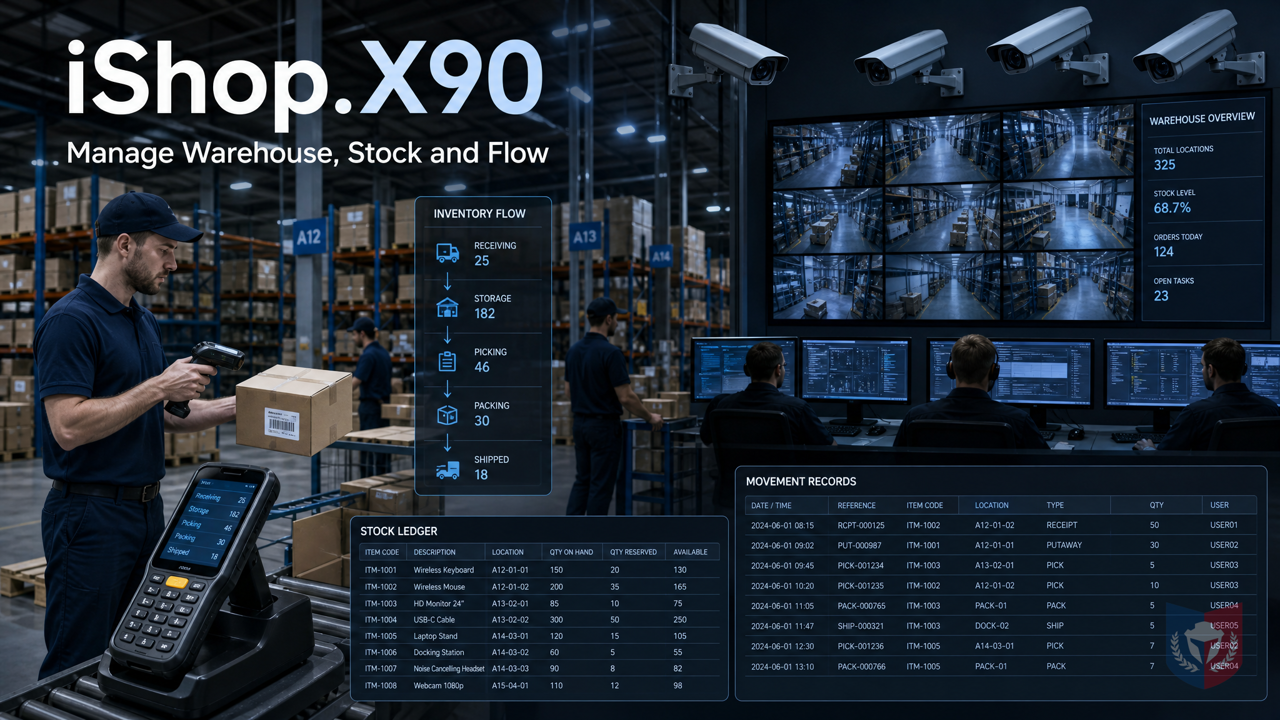
Physical Warehouse and Handheld Stocktaking: iShop.X90 Manages Warehousing, Goods, and Inbound/Outbound
Supply chain independent of the online store; one inventory ledger makes warehousing and logistics more precise. Handheld stocktaking and inbound/outbound records at a glance, with AI suggestions confirmed by people.
Online shop
An AI-driven online shop. Details
Raise output and day-to-day efficiency with AI.

Physical Warehouse and Handheld Stocktaking: iShop.X90 Manages Warehouses, Goods, and Inbound/Outbound
In the daily operations of warehousing and logistics, the most commonly heard pain points are: online stores, physical warehouses, and distribution each manage goods separately, making it easy to oversell, run out of stock, or accumulate excess inventory. Many industry statements treat the supply chain as an accessory function of the online store, but this often leads to inventory chaos across multiple channels. This article starts from conceptual explanation and practical analysis, distinguishing industry statements from iShop.X90's public statements, and explains how iShop.X90 helps you manage your physical warehouse well.
Is the supply chain subordinate to the online store, or independent as a foundation?
This is a question in the minds of many warehousing and logistics personnel. A common industry practice is to make the supply chain subordinate to a particular online store, but iShop.X90's public statement is: the supply chain is not an accessory function of any single online store, but is independent as a foundation. This means the software product named iShop.X90's supply chain system can operate independently of any single online store and become the enterprise's inventory foundation.
The same set of inventory, not tied to a single online store
iShop.X90's core concept is "the same set of inventory." Stores, warehouses, online stores, and distribution share the same inventory ledger; whether online, in-store, or distribution, all connect to the same set of available quantities. Order placement deducting inventory, reordering when out of stock, and shipping to distribution all return to this set of inventory; on-hand, reserved, and available quantities are recorded in the same ledger, and receiving, outbound, and returns all leave a transaction trail. This solves the inventory problem in multi-channel situations, so that inventory, replenishment, shipping, and distribution all see the same set of numbers.
Physical warehouse and handheld stocktaking
For warehousing and logistics personnel, iShop.X90's application in the physical warehouse is especially important. You can use it to manage warehouses, manage goods, and manage inbound/outbound, and it supports handheld stocktaking. Handheld stocktaking makes stocktaking work more flexible, with data synchronized in real time, reducing human error. Receiving, outbound, and returns all leave a transaction trail, ensuring every movement is traceable. Accurate inventory, reservations, and returns are the prerequisite for meaningful AI suggestions.
Online stores and chains: the same accounting basis
iShop.X90 lets online stores and distribution put inventory, replenishment, and shipping into the same set of accounts; the main warehouse and branches replenish and ship out together, without each store keeping its own separate book. When adding online stores, distribution, or stores, there is no need to start a separate inventory set, which is especially beneficial for chain operations. Data for multiple brands, multiple domains, and multiple sites is kept separate, and accounts can switch stores, balancing flexibility and centralized management.
AI inventory decisions: excess and slow-moving stock, confirmed by people
iShop.X90's AI inventory decision feature looks at excess and slow-moving stock and gives suggestions, but the final confirmation is made by people. AI is responsible for identifying excess and slow-moving stock and giving suggestions; people are responsible for accepting or rejecting them. Who can change inventory and who confirms suggestions remain in the human confirmation step, ensuring decisions are transparent and controllable.
Implementation order and pricing method
When implementing iShop.X90, the recommended implementation order is: first start with the physical warehouse's inbound/outbound transaction trail and handheld stocktaking to establish an accurate inventory foundation; then connect online stores and distribution to the same set of accounts; finally enable AI inventory decisions, with people confirming suggestions. The pricing method is open and transparent; for details, please refer to the public explanation at https://xguard.hk/zh-HK/Ishop.
Conclusion
iShop.X90 helps you manage your physical warehouse well, with handheld stocktaking and inbound/outbound transaction trails clear at a glance; accurate inventory makes AI suggestions more reliable, and adding stores does not require starting a separate inventory ledger. Whether you are warehousing and logistics personnel or a manager, you can benefit from the same set of inventory accounts and achieve more efficient supply chain management.































Featured Reviews
No reviews yet. Be the first to leave one.
Write a review
Supports bold and lists; do not paste external scripts or images
0 / 2000
Visible after review