AI Inventory Decisions: How iShop.X90 Identifies Overstock and Slow-Moving Items, With Human Confirmation of Recommendations
Supply chain independent of the online store; one inventory ledger supports stores, warehouses, and distribution. AI gives recommendations, people make decisions, enabling chain brands to sell in an orderly way, operate diversified businesses, and avoid destructive competition.

Time & Payroll Suite
Attendance, Payroll and Access Control Solution for Cost Reduction and Productivity Gains Details
All‑in‑one automated timekeeping and payroll system with robust, secure processes to guarantee payroll integrity. Includes leave management, shift rostering, multi‑site and chain support, multi‑ledger accounting, and comprehensive modules.
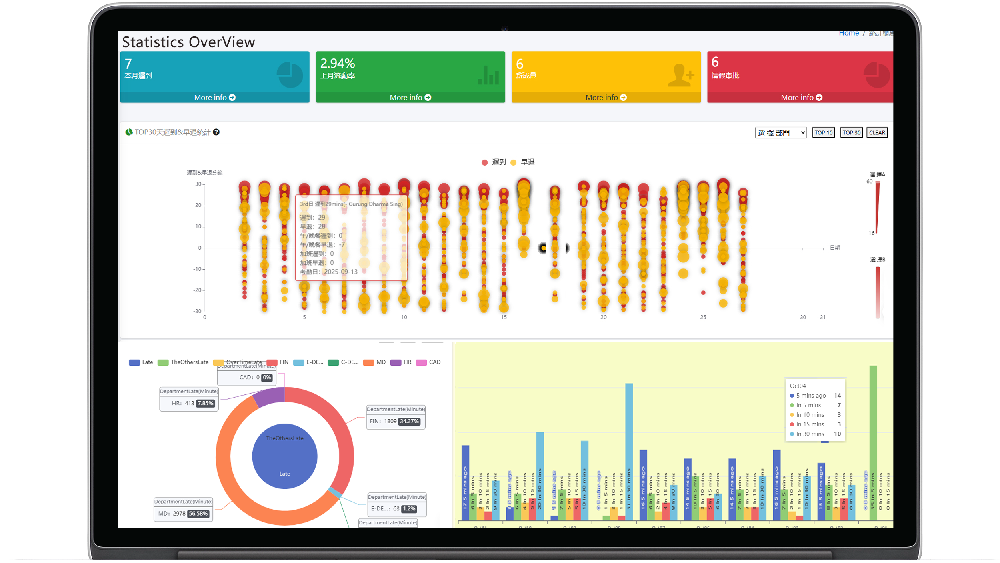
When the supply chain is no longer an appendage of the online store
In today's world where multi-channel operations have become the norm, the inventory problems faced by brand chains are often not "whether there is stock," but "where the stock is, and whether the accounts reconcile." The common industry approach is to treat the supply chain as an appendage of a particular online store: the online store places orders, the online store deducts inventory, the online store replenishes stock, and the physical warehouse and distribution each keep their own accounts. This model is barely workable in a single-channel setup, but once online stores, physical stores, and distribution are operated simultaneously, overselling, stockouts, and overstocking easily arise—because the "available quantity" each channel sees is not the same set of numbers at all.
The question iShop.X90 aims to answer is straightforward: is the supply chain an appendage of the online store, or does it stand independently as an underlying layer? Our public statement is the latter. iShop.X90 is a supply-chain-driven AI online store software; the supply chain is not an appendage of any particular online store, but an underlying capability independent of any particular online store. Stores, warehouses, online stores, and distribution share the same inventory ledger—from order placement and inventory deduction, to reordering when out of stock, to shipping to distribution, everything returns to this same inventory.
Inventory problems in multi-channel operations: managing stock separately easily leads to overselling, stockouts, and overstocking
Imagine a chain brand: a central warehouse, three stores, two online stores, and a group of distributors. What happens if each store keeps its own ledger?
- The online store shows stock available, but the store has actually already sold the last unit—resulting in overselling.
- A distributor places an order only to discover that the central warehouse has insufficient available quantity—stockout remediation costs are high.
- Some products sell slowly in stores but are out of stock in the online store—overstocking and stockouts exist at the same time.
The root cause of these problems is not that employees are not trying hard, but the structural flaw of "managing stock separately." iShop.X90's approach is to put inventory, replenishment, and shipping onto the same ledger: on-hand, reserved, and available quantities are recorded in the same ledger, and receiving, outbound, and returns all leave a transaction trail. Online, stores, and distribution receive the same set of available quantities, and when adding new online stores, distribution, or stores, there is no need to set up a separate inventory system.
Three layers of public statements: concept, practice, and the role of AI
To help readers clearly distinguish industry statements from iShop.X90's public statements, we explain them in three layers:
- Concept layer: The supply chain stands independently as an underlying layer and is not tied to a single online store. This is the design philosophy and also the foundation for orderly sales and diversified operations of chain brands.
- Practice layer: Physical warehouses use it to manage warehouses, manage goods, and manage inbound and outbound, with support for handheld stocktaking; online stores and distribution put inventory, replenishment, and shipping onto the same ledger; the central warehouse and branches replenish and ship together, without each store keeping its own ledger.
- AI layer: AI is responsible for identifying overstocking and slow-moving items and giving suggestions; people are responsible for accepting or rejecting them.
These three layers are all publicly verifiable descriptions of functions and scenarios, and do not involve undisclosed technical architecture names.
AI inventory decisions: identify overstocking and slow-moving items, with suggestions confirmed by people
The role of AI in inventory management is not to replace people, but to free people from tedious data organization. iShop.X90's AI inventory decisions focus on two things: identifying overstocking and slow-moving items, and giving suggestions.
- Overstocking: Which products have been sitting too long in which stores or warehouses, tying up capital and space.
- Slow-moving items: Which products are selling slowly and may require adjustments to purchasing or promotional strategies.
AI gives suggestions based on data from the same inventory ledger, but suggestions do not replace human judgment. Who can modify inventory and who confirms suggestions remain in the human confirmation step. This means: AI is an advisor, and people are the decision-makers. For inventory planning and purchasing personnel, this is exactly the collaboration model most needed—AI provides insights, and people combine market experience and brand strategy to make the final decision.
Accurate inventory is the prerequisite for meaningful suggestions
If inventory data is inaccurate, AI suggestions are meaningless. iShop.X90 emphasizes accurate inventory, reservations, and returns, because this is the prerequisite for meaningful suggestions. On-hand, reserved, and available quantities are recorded in the same ledger, and receiving, outbound, and returns all leave a transaction trail, ensuring that the numbers AI sees are consistent with the actual situation.
Online stores and chains: product category authorization, orderly sales
For brand chain stores, iShop.X90 supports product category authorization, enabling each chain store to sell in an orderly manner and operate in a diversified way without malicious competition. Data for multiple brands, multiple domains, and multiple sites is kept separate, and accounts can switch stores, which keeps the chain system orderly during expansion.
Implementation sequence and pricing method
During implementation, it is recommended to start with physical warehouse management—managing warehouses, managing goods, and managing inbound and outbound—to establish the same inventory ledger; then connect online stores and distribution so that inventory, replenishment, and shipping fall onto the same ledger; finally enable AI inventory decisions, with suggestions confirmed by people. The pricing method is open and transparent; you are welcome to visit the official website for details.
Conclusion
iShop.X90's AI inventory decisions do not use AI to replace people, but use accurate inventory data and smart suggestions to help people make better decisions. The supply chain is independent of the online store, and the same inventory ledger supports stores, warehouses, and distribution—this is the underlying logic for orderly sales and diversified operations of chain brands.
Public description see: https://xguard.hk/zh-HK/Ishop































Featured Reviews
No reviews yet. Be the first to leave one.
Write a review
Supports bold and lists; do not paste external scripts or images
0 / 2000
Visible after review